Planarian_prista4d
Abstract
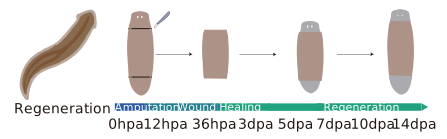
Understanding how organisms reconstruct complex tissue architectures following injury requires precise mapping of gene expression and cellular responses across space and time. Although planarians serve as a classic model for whole-body regeneration, capturing the continuous spatiotemporal dynamics of positional information and cell fate decisions at the organismal scale remains a significant challenge.Using high-definition spatial transcriptomics, we generated a 4-dimensional atlas encompassing over 3.5 million cells from whole animals across 8 distinct regeneration timepoints. This comprehensive dataset enabled the definition of 36 spatial domains and the tracing of body axis restoration, revealing that positional control genes recover through self-organizing dynamics analogous to an underdamped control system. We identified an injury-induced spatial domain termed the anterior regenerative zone. This unique region is characterized by the convergence of epidermal, muscular, and neural lineages enriched with positional signals. Furthermore, we demonstrated that the transcriptional co-factor Mediator 8 is a critical regulator of this zone. Depletion of Mediator 8 impairs the formation of the anterior regenerative zone, disrupts polarity establishment, and prevents successful blastema formation.Our study provides a holistic molecular and cellular reconstruction of whole-body regeneration, directly linking dynamic gene expression gradients to morphological restoration. The discovery of the Mediator 8-regulated anterior regenerative zone highlights the importance of spatial domains in coordinating tissue repair. The resulting interactive atlas serves as a foundational resource for deciphering the logic of spatiotemporal patterning in regeneration.
Available Analysis Tools
Tools available for this dataset