Drosophila_STDS0000060
Abstract
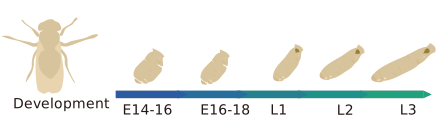
Drosophila has long been a successful model organism in multiple biomedical fields. Spatial gene expression patterns are critical for the understanding of complex pathways and interactions, whereas temporal gene expression changes are vital for studying highly dynamic physiological activities. Systematic studies in Drosophila are still impeded by the lack of spatiotemporal transcriptomic information. Here, utilizing spatial enhanced resolution omics-sequencing (Stereo-seq), we dissected the spatiotemporal transcriptomic changes of developing Drosophila with high resolution and sensitivity. We demonstrated that Stereo-seq data can be used for the 3D reconstruction of the spatial transcriptomes of Drosophila embryos and larvae. With these 3D models, we identified functional subregions in embryonic and larval midguts, uncovered spatial cell state dynamics of larval testis, and revealed known and potential regulons of transcription factors within their topographic background. Our data provide the Drosophila research community with useful resources of organism-wide spatiotemporally resolved transcriptomic information across developmental stages.
Available Analysis Tools
Tools available for this dataset